Monday, June 23, 2014

Pass the Worm Juice!


We’ve now been making “worm juice” for about 5 months and are having good results.  We’re nearly r
Our garden is doing well using the worm juice our worms have
produced.  We use no other fertilizers.  And as for
weed control, we use cardboard, paper,
hay and mulch.
eady to share it with others who are interested in organic fertilizer for their house plants or gardens.
WHAT IS WORM JUICE?

We’re glad you asked!  It’s a by-product of nature in a liquid form.  Worm Juice is rich in good nitrogen fixing bacteria, and the key is that the bacteria are ready-available minerals and trace elements so it can be immediately used by your plants.
We have several worm farms in our barn right now, eating our kitchen vegetable scraps along with the soil we give them.  As worms break­down the food source they pro­duce a liq­uid that will fall to the low­est part of the container and drip into a bucket we keep under it. This juice is liq­uid gold as it works as an amaz­ing fer­til­izer. The great thing is you don’t need that much either. The ratio can be as much as 9:1 water: worm juice. How­ever the ratio will dif­fer depend­ing on how much we water our worms.  Sounds odd perhaps, but the lit­tle crit­ters don’t like it to be dry in there so we try to keep the envi­ron­ment as moist as pos­si­ble.

The best worm juice should look like a light brown, something like a weak cup of tea.

The worms produce a lot more of this juice in the warmer months and less in the cooler months.  But an overabundance of it in the summer can be saved until it is needed later!

Most of the “ingredients” that we put in our worm farms are organic table scraps from vegetables and fruits along with other compost.  The worms make wonderful compost and also leave behind the liquid which we drain from the bottom of the containers and put into gallon jugs.  This liquid can be mixed with water and then given directly to your house plants or garden plants for a boost in nutrition.

We are still learning proper use and have not had our “juice” tested yet.  In the past, we have seen the following results from others who have had theirs tested:

·         pH – 8.5: That’s a high pH for soil, but for a fertilizer added every week or two it’s fine.

·         Nitrogen – 1120 ppm: That’s high for a fertilizer.  About twice the concentration I’d use if I were applying a liquid fertilizer to my plants at home. The nitrogen is present mostly as nitrate, which is a good thing.  If the nitrogen were present primarily as ammonium, that might cause problems.

·         Phosphorus – 22 ppm: That’s a good/appropriate concentration of phosphorus for most plants. It’s much less than we apply when we use a typical garden fertilizer. Potassium – 5034 ppm: This is an order of magnitude higher than we’d apply for most plants using a liquid fertilizer.

·         Calcium – 279 ppm: This is a reasonable amount of calcium.

·         Magnesium – 211 ppm: This is reasonable amount of magnesium.

·         Sodium – 634 ppm

·         Other elements present included Iron, Copper, Manganese, Zinc, Molybdenum, and Boron, all at levels less than 1 ppm.

Our conclusion so far is that this makes an excellent liquid fertilizer if it is used properly.  Diluting it is important and applying it only once each week or two seems appropriate.  We are also sure not to get it on the leaves of the plants, only on the soil below.
This is a great way to avoid those chemical plant fertilizers by using own design in nature, and it’s affordable too.

You can start your own worm farm too - a great homeschool project for any family.

Here's just a little to get you started:  http://www.veryediblegardens.com/iveg/worms

Don't want to deal with worms?  We'll be selling our worm juice to all who are interested very soon!

Wednesday, June 18, 2014

Why We Avoid GMO's


Just a few years ago I had never heard of GMOs (Genetically Modified Organisms).  After learning about my daughter's rare epilepsy and after doing tons of research, my eyes were opened.
This, along with the blessing from the Lord to run across other moms who had the similar or same issues with their children, helped me begin a process of being more involved with the food we ate. 

During this time I witnessed two moms  heal their children from autism and severe epilepsy, respectively.  I saw grand mal seizures every month go to zero seizures almost immediately after switching eating habits.  While we are still working on being disciplined in this area, I am constantly trying to do what I can to improve our food sources.

The more I learn the more I want to share with others who may not want to spend much of their lives researching food!   I suspect that many food companies count on people not willing to do the research or make changes in their eating habits.  They count on it so that they can continue to do what is most profitable.  This is likely the reason there is such a fuss right now with companies fighting to avoid labeling their foods when they contain GMOs.  An uninformed public is better for them.

Let me be sure to say that while I do believe that ultimately the Lord is in control, I also know that He says "money is the root of all evil" and this is a perfect example.  GMO foods make some companies a lot of money... at the expense of our health.  It is important for us all to be alert and understand what we are eating and feeding our children.

Perhaps you don't see any health issues in your family.  I can say this, once finding a health issue in our family, suddenly making these changes became of upmost importance. 
And just because you don't see it right now, doesn't mean nothing is happening underneath.

Can folks continue to eat GMOs without ill effect?  I believe 100% NO.  We simply can't eat pesticides and herbicides and experience no ill effect.  Yes, perhaps some will not see the effects for many years and maybe some will live without ever seeing any.  I can say I have heard of a few people who have smoked their entire lives and never had lung cancer... but that doesn't mean it's healthy.

So with that intro, here is some information for you to break it down into simple terms.


GMO's — or genetically modified organisms — are plants or animals created through gene splicing techniques. They are foods created by merging DNA from different species.

The first GMO crop (the Flavr Savr tomato) was approved by the FDA in 1994. Since then, GMO (or GE) varieties of corn, soya, sugar beets and canola have become common local crops in Canada and the U.S.  In a mere 20 years, GMO ingredients have made their way into most of the processed foods available on grocery shelves.
 
Amazingly, many countries have outlawed them and will not purchase our American GMO corn.  America is not exporting much, instead we are eating it ourselves and feeding it to the animals we eat.  So we are getting large quantities of this in our diets.

GMO crops, when first introduced, were touted as the answer to world hunger. The argument was that by developing pesticide and herbicide resistant crops, farmer's would be able to increase their yields and decrease their costs. This has not proven to be the case. Instead, bugs and weeds have become increasingly resistant to the widespread applications of these chemicals, leading to increased use of both. More spraying means more costs for the farmers, more damage to the environment and more health concerns.
 
However, this means more product purchased from the seed producer.  The companies that develop and patent GMO seeds are the same companies that develop and patent the pesticides and herbicides to which the unique seeds are resistant.  Monsanto (and now Dow) is the largest seed company in the world and owns about 86% of GMO seeds globally.  It is also the parent of Roundup.  (I'll post about Roundup another time).
 
By eating GMOs we are eating large quantities of pesticides and herbicides.  No doubt about it.  No one can convince me this is a healthy thing to do.  The safety which these companies tout is unproven and more and more research is showing that these foods are not only effecting our healthy but also doing environmental damage.  Most nations have policies requiring mandatory labeling of GMO foods at the very least, and many have banned them completely.  But not here in the USA.
 
Many people are unaware that the foods they choose contain GMO ingredients.  They are in nearly everything.  If you purchase processed foods with anything made from corn, you can be certain you're eating GMO corn.  If you purchase beef at the local grocery, that cow was eating GMO grains.  We aren't eating small quantities of it, we're eating TONS of it.
 
We are currently struggling to find non-GMO corn for our chickens and have learned that there is NO organic, non-GMO corn produced anywhere in Missouri.  Except one small farm that has just finished a 5-year process to become organic, USDA approved.  They are an Amish family.  The cost of their highly nutritious chicken feed is 4x the cost of the GMO feed.  The government requirements are so costly that they have no choice but to raise these prices.  Personally, if I had to pay $5.00 for a dozen eggs, I would do it in order to get REAL eggs.  Many people spend more than that each day at Starbucks.  It's all about choices.
 
While we're thankful to have at least one farm growing grains the right way - we still have the possibility of cross-contamination of Monsanto's seeds.  (And as a side note, did you know that if any of Monsanto's seeds were to blow onto our property and contaminate our field, that they could sue us for "stealing" their patented seeds?  Craziness!)
 
So what can you do?  Here are some ideas:
  • Read labels and avoid anything with soy, corn or canola oil.
  • Purchase as much organic as possible.  Google the "top ten pesticide filled vegis" to get an idea of where to start.  For example, apples and strawberries are typically sprayed the most so start with those if you can't afford to buy all your vegis organic.
  • Shop at local farmer's markets where you can get to know your farmer and their practices.  You're taste buds will also thank you!
  • Grow a garden in your backyard.  Even a small one is a great start.
  • If you have the space, get a few chickens.  They provide natural pest control, keep the grass cut for you, fertilize your yard naturally, and provide eggs as a by-product.  :-)  A back-yard flock is the best thing going.
  • Stop using Roundup and other weed killers around your home.  White vinegar, salt water - work great for weed killing.  Or just pull them, or learn to live with them!
  • Avoid milk products unless you can get them from organic, raw milk.  There are many here in Missouri who are raising healthy dairy cows and would love to sell you some raw milk.  Again, your taste buds will also thank you.  Our family avoids all pasteurized foods now and have reaped many health benefits from it.  You can find cheddar cheese made from raw milk at Trader Joes for a reasonable price too!
  • Stay informed.  Take a few minutes to find information.  The internet makes it easy to find what you need, and isn't your health worth it?  If you learned you had cancer tomorrow - wouldn't you be learning all you could about it?  Don't wait for health to fail you - research now and make changes a little at a time.  You'll be glad you did!
The only remedy for staying away from GMO-filled foods is a change in eating.  This change is pretty simple but just a little pricey.  Still, much cheaper than all of the medicines we would be paying for otherwise.
The U.S. National Organic Program forbids the use of GMO practices, so eating as organic as possible is the only way to stay away from GMOs.  Look for the GMO-free label on products you by.  And most importantly, stay away from highly-processed foods.
 
To see the top 10 GMO foods, you can check out this informative video:
 
 
God gave us all we need to be healthy.  While we may still suffer from sickness (as we are a fallen people), we can do many things to improve our health.  Satan doesn't just work hard on our spirit, he also attacks our health so that we will not be well enough to serve others!  We must always be alert.... but we can enjoy eating more naturally and reap the rewards from it as well!


Sunday, May 4, 2014

New Chickens!

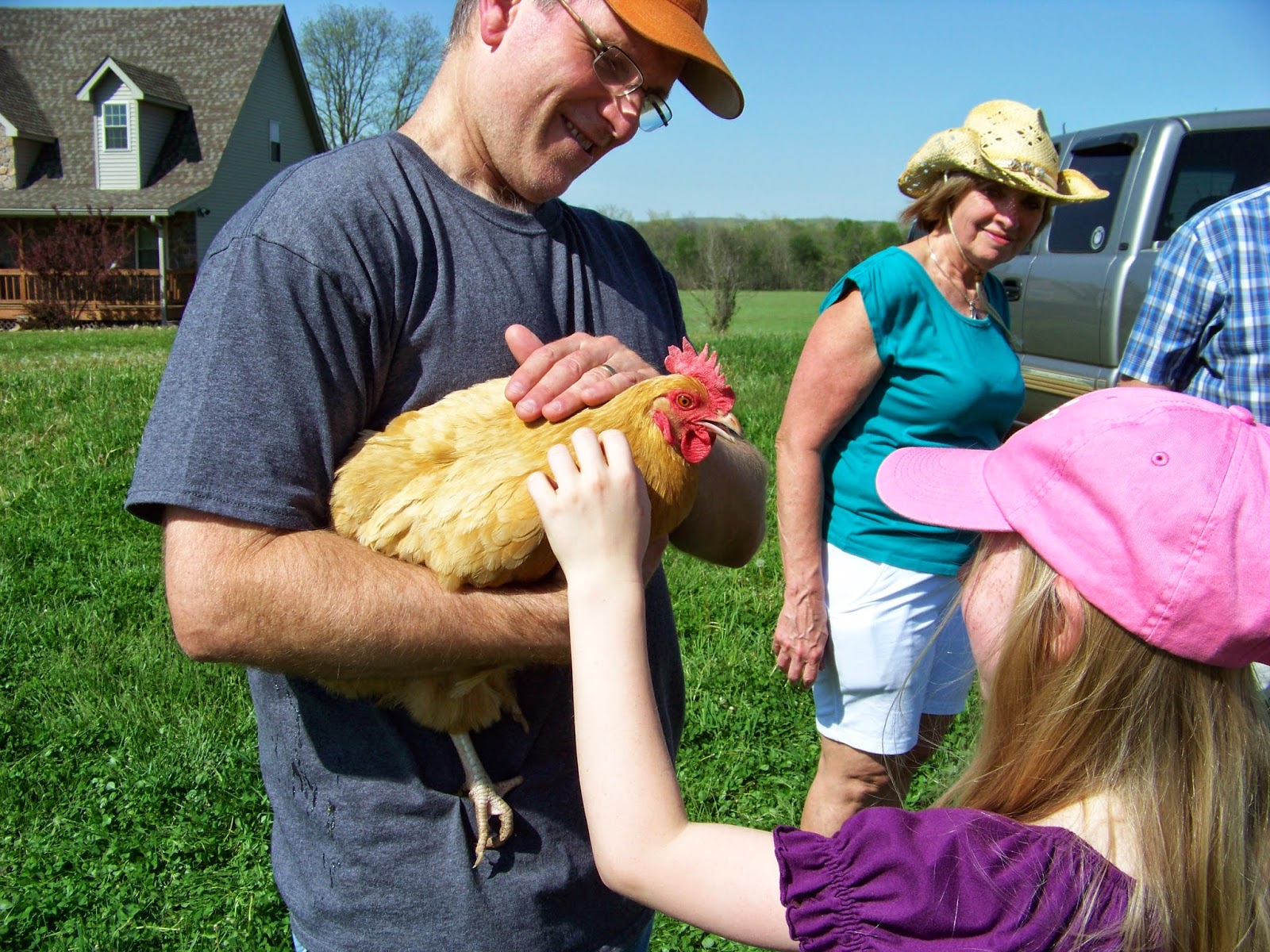
Operation "Chicken Move" happened this weekend and we were all very excited.

We finished our new chicken tractor with the help of some sweet neighbors.  And then we moved 22 chickens from across the street over to our place.  They are happy as can be now, settling in for just 1 hour and already laying 2 eggs.

Here's some pictures of the fun.
 
Happy to be out of the back of the truck!

 This girl was an escapee and super hard to catch.  She was fast, but we finally won the chase!


 Putting them in their new home.
 
 Our "Chicken Tractor" Joel Salatin style.
 
This coop on wheels is moved 2-3 times per day so they are always on fresh ground with plenty to scratch and eat.  Also, it is a natural fertilizer for our grass and hay - as well as a natural bug removal system!
 
This is a safe shelter for the hens while providing access to sunlight (a natural disinfectant), weeds and clovers and other greens, as well as bugs which are very nutritious protein.
 
This cuts down on the amount of grain they consume which makes a healthier chicken and a healthier egg!


Happy in their new home!
 
When you see "free-range" on an egg carton, it really means they "have access to outdoors"
This is a whole new free-range experience.  They not only have access to outdoors, but they have non-stop access to fresh greens and bugs. 

 The next batch goes in.


We love our new chickens!
 
Currently, our chickens are fed primarily organic vegies from our kitchen scraps, worms from our worm farm, bugs they catch on their own, and green grass and clover.  We never spray anything on our grass, it is all natural!
 
We supplement the chickens diet with chicken feed.  It is an all-natural feed which simply means it does not contain fillers or any medications.  We are working with a local feed supply to order a non-GMO, organic mix as soon as possible.  We will also be getting kelp which is very nutritious for chickens. 
 
We were sad to hear from the local suppliers that there is no NON-GMO corn in the entire state of Missouri!  To combat this, we will have to special order the feed we want for our chickens.  We are committed to doing whatever it takes to make our chickens and eggs as healthy as they can be.  We've already gotten several other small farmers interested in this so we'll be able to order enough bulk for the feed supplier to mix it for us.
 
Our hope and plan is that within the next two weeks our chickens will be on a non-GMO,organic feed from here on out! 
 
"Thou wilt show me the path of life: in Thy presence is fullness of joy; at Thy right hand are pleasures forevermore."
Psalms 16:11
 

Wednesday, April 16, 2014

The Pig Farm Visit


Over six years ago, we had a unique opportunity to visit a conventional hog farm in rural Minnesota.  We 'won' this opportunity by bidding at an auction being held as a fund-raiser for a local Montessori school.  The woman who donated this auction item was related to the owner of the hog farm.  She convinced him to allow three families with small children, to visit and tour their operation.  We were one of those families.
We were warned up front that there would be no cameras allowed.  However, the owner offered to snap a few for us and then send them too us.  This should have been a clue as to what we were about to witness.

After a 1.5 hour drive, we arrived at rather empty looking field among corn fields, with one large building on it.  It didn’t look like what I envisioned a pig farm to be.  I was thinking we’d drive up and see barns and little piglets running around.  No sign of a pig was anywhere.  We were greeted and went inside to a sort of entry/office room of this large building.  In that first room, with still no pigs in sight, the smell was so strong that many of us thought we might not be able to continue.  We were given masks, coverings for our feet, coverings for our clothes, and gloves as well.  As for the smell, we were told we would “get used to it.”  (I later found that this was not true for me.)
After some introduction, we were taken in to the main rooms of this pig operation.  We were guided through a maze of cages, pens and crowded pigs.  It was full of sights, sounds and smells, like none I’ve ever witnessed.   We were told many things about how it is all run.  None of these pigs have ever seen the sun or dirt or anything but a grated floor.  Many are in pens so small they cannot turn around or even lay down.  As Joel Salatin would say... "Folks, This Ain't Normal."  Even at that time, with my lack of knowledge around how meat should be raised, I knew in my gut that this couldn't be right.

It didn’t take long for me to realize why no pictures were allowed.  I cannot begin to describe what I witnessed.  The sights and smells were overwhelming.  The conditions were deplorable.  It was very hard to walk through that place without crying.  It was hard to get the images out of my mind.  It still is.

One of the slightly less sad places was a room for the
momma's and babies.  The owner was kind enough
to take this photo for us.

Now I do believe in raising and eating meat – but I also believe that God intends us to be good stewards.  I’m certain that these pigs were not intended to live this way.  
Later, after the tour, we sat down with the owners to eat.  I wasn’t hungry so I listened to the conversation.  Several things were discussed about this type of operation verses a free-range pig “farm”.  Even the owner himself seemed to be saying things that were justifying his decision to run this operation in this way.  He didn't sound like it was a joy or a pleasure to be there.  I remember so clearly him explaining that the pigs are safer here as they could get sunburned if they were outside.  He also stated that these pigs were bred to be indoors, they were so large that they could break a leg if they were to run around outside.   He explained the trouble they ran into when someone learned that they had made the cages even smaller years before, and then explained the reasons why they had to do it.  It was as if they had their hands tied, or thought they did.

The truth is:  Pork from pigs that are raised outdoors produces the highest amounts of Vitamin D available to us, even more than milk.   Pork that comes from these conventional factories has little to zero vitamin D. Sunlight is also a natural detoxifier and germ-killer.  Far fewer drugs are needed on pigs raised outdoors.  In fact, no drugs are needed in most cases, for animals raised outdoors in proper conditions.
Pigs were given a snout on the end of their noses for a reason.  To root and dig!

This small hog farmer later explained that he used to raise his animals outside in the fresh air, but he no longer could afford to do it because of the increased regulations.  He had “no choice” but to sell out to a larger corporation and then had to do it this way or he could not stay in business.  So even this farmer saw the problems with the way he  was raising these hogs – but felt helpless to do anything about it.
We didn’t eat pork for nearly 5 years after that experience.  No one in our family wanted to.  It was too much to bear to remember it, both the cruelty and the terrible conditions of the place in which our food was bring raised.  This couldn’t be healthy to eat, we thought. 

Today, we’ve learned so much more about the condition of much of our food.  We do eat pork now.  But only from pigs who are raised outdoors and are allowed to really be pigs!

We’ve seen pigs rooting around for acorns, in a sustainable, affordable way that actually enhances the land.  We’ve seen one creative farmer after another, raising pigs using things such as old political signs as shelter from the sun. We’ve seen others using electric, movable fencing which keeps fresh ground under the pigs daily – allowing the land to rest in between moves. 

Now these are pigs the way God intended!  A good, respectful
life and a much healthier meal!
We are so encouraged by these farmers who are leading the way in what is unconventional today.  Search out your local small farmer – you’ll find one if you look.  Find meat that you can visit and see for yourself the health of your food.
Pictures will always be allowed on our farm!


This is how one should regard us, as servants of Christ and stewards
of the mysteries of God.
- 1 Corinthians 4:1
 

Thursday, April 3, 2014

Chickens are NOT Vegetarians

Are your chickens fed a vegetarian diet?"
 "ABSOLUTELY NOT!!!

Happy Chickens!
We want to avoid unnaturally feed for our chickens.

 Not everyone is aware since the marketing is so contrary these days.... but chickens are omnivores, meaning they eat both plants and animals. Ask any farmer with a flock of pastured poultry how much their hens squawk in a frenzied delight at the discovery of a worm, lizard or snake. A full-scale party in the hen house breaks out in the barnyard when a hen nabs a coveted live morsel.

Chickens are notorious cannibals, even pecking injured flockmates to death. This is one of the reasons commercial chicken operations de-beak their birds when they stuff them into cages and buildings by the tens of thousands. This is rarely a problem when birds are raised properly.
Our birds will get worms, bugs, weeds and vegetables and sometimes even flowers!  By the way, that is a dirty little trick the commercial laying hens get to bump up the color of their yolks... adding dried marigold flowers to the feed.  Looks great, but means nothing.

Truth is, chickens running around in the sun, absorbing sun light, eating a varied diet, produce a naturally bright colored orange egg yolk.  The healthier the chicken, the healthier the egg!
I was introduced to a Purdue Farms commercial in a store recently which emphasized their chickens were fed an all-vegetarian diet.
A vegetarian chicken is NOT an "All Natural Chicken", it is an abused and unhealthy chicken. 
The marketing teams are creative and understandably so.

However, the truth is this:  Commercial chicken operations used to feed their poultry animal by-products including .... chicken manure!)  Now that it is discovered that isn't the way to go, they now advertise vegetarian diet as a way to say they aren't feeding their chickens this very yucky stuff!

Did you know,  the poop from vegetarian chickens is being fed to cattle in both the beef and dairy industries. Why? It's a cheap form of food. However, the practice was prohibited with the advent of Mad Cow disease. Turned out that this practice polluted the animal by-products used in poultry feed and eventually infected said bovine with Bovine spongiform encephalopathy (BSE) and potentially infected humans as well. So under the guise of food safety, our chickens must now be vegetarians.

So next time you see "all vegetarian feed"  on your poultry products (yes, even if you buy them at Whole Foods or they are Certified Organic), remember you are contributing to unnatural agricultural practices implemented solely for bigger profits in the industrial food production complex and not to the benefit of the livestock or more importantly, your health.
This is "cage-free" and "free-roaming".
But there is a solution.  More and more people are finding their local farmers and getting eggs from a source they can actually visit and see for themselves!  Or even better, others are starting their own backyard flock of hens.  Even in small yards, many times it is possible to have chickens (minus the rooster!)
 
So look around and see if you can find a farmer in your community who is raising a healthy flock.  You'll be surprised at the difference and enjoy eating healthy food.


Every moving thing that lives shall be food for you. And as I gave you the green plants, I give you everything. - Genesis 9:3

Monday, March 24, 2014

Monsanto


Diane Drinkard shared this several years ago.The American nursery trade is a 39.6 billion dollar a year industry. With the purchase of Seminis in January of 2005, Monsanto is now estimated to control between 85 and 90 percent of the U.S. nursery market. This includes the pesticide, herbicide and fertilizer markets. By merging with or buying up the competition, dominating genetic technology, and lobbying the government to make saving seeds illegal, this monolith has positioned itself as the largest player in the gardening game.


Monsanto holds over eleven thousand U.S. seed patents. When Americans buy garden seed and supplies, most of the time they are buying from Monsanto regardless of who the retailer is.


Most home gardeners started noticing the initials PVP appearing next to selections in the mail order garden catalogs a few years ago. This stands for Plant Variety Protection. It means the seed or plant carries a U.S. patent. It is illegal to save seed from or otherwise propagate PVP varieties. Consumers will have to buy more each year if they wish to grow a PVP variety.

Greenpeace chides, “Monsanto-no food shall be grown that we don’t own.”

They could be right. Terminator Technology promises to be a big money maker for Monsanto and its subsidiaries. Plants are genetically modified so they won’t produce seed, or if seed is produced, it is sterile. With this maneuver they are guaranteed a continuing market for vegetable, fruit, and flower seed.

Consider the newest Frankenstein called Traitor technology. This charming little piece of genetic engineering will help Monsanto’s chemical division rake in billions of dollars a year from across the globe. It allows growers to control the genetic traits of plants by applying an array of chemicals, all owned by Monsanto. Do your genetically modified watermelons have blight? No problem, for a price you can buy the chemical that will turn on the plant’s blight fighting gene. No kidding. It is estimated Traitor technology could dominate world seed supply with an astonishing 80 percent of the market by 2010.

Six companies Du Pont, Mitsui, Monsanto, Syngent, Aventis and Dow control 98 percent of the world’s seeds. These companies are opening research facilities and acquiring local seed companies and farmland on every continent, and they can’t do it fast enough.

Imports of seed and stock from Pakistan, India, Mexico, Thailand and of course China, are on the rise. Countries like Thailand boast of seed exports rising at 12 percent per year from 1998-2001. American seed exports fell at twice that rate for the same time period. As biotechnology forges on, something is lost. At first it is barely noticeable, just a sense that something is different.

  Ashes, ashes, all fall down.... Before it was acquired by Monsanto, Seminis eliminated 2,000 varieties of seed from its inventory. The first things to go were the older open-pollinated varieties-vining petunias, butterfly weed, butter beans, German green tomatoes, and other heirlooms grown by gardeners for generations, replaced by genetically engineered varieties.


High-tech patented hybrid varieties are far more profitable for transnational seed companies to produce and sell. These new Frankenseeds are bred to perform adequately over a wide geographical area, giving the patent holder a much larger market.

As consumers are losing the freedom to choose what they will buy and grow, thousands of varieties of garden seed are walking the plank, straight into the abyss of extinction. Consider this, in 1981 there were approximately 5,000 vegetable seed varieties available in U.S. catalogs. Today there are less than 500, a 90 percent reduction.

Seeds removed from commercial production are left in private corporate seed banks. Open pollinated seed will not store indefinitely, it must be propagated to ensure its survival. This is an expensive proposal, one not likely to happen in the world of capital consolidation and wide profit margins.

The more likely scenario is the “unprofitable” heirloom seeds will be allowed to expire and patented hybrids will take their place. Seed biodiversity will be compromised globally, while the corporate stranglehold tightens around the throat of the consumer.

Kent Whealey, co-founder of Seed Savers Exchange, says “Few gardeners comprehend the true scope of their garden heritage or how much is in immediate danger of being lost forever.”


Taking the ball and going home Like the glaciers that rolled across North America, heaving and prying the earth into new forms, giant transnational seed companies are changing the face of gardening as it once was. What’s left behind is the product of a destructive force to be sure, but something beautiful and promising also remains.


Across the globe people are growing and saving heirloom seeds, ensuring the promise of diversity and heritage for future generations. Groups like Seed Savers Exchange are blooming in the remains of corporate devastation. Some of these organizations are large, offering seeds from across the globe. Others are neighborhood and regional groups saving and trading local favorites. Whatever their size, they are dedicated to preserving the earth’s biodiversity. All it takes to form a seed saving club is for one neighbor to pick up the phone and say to another, “Do you want to trade some seeds this year?” There you have it, a seed saving club.

Imagine if one neighbor called another neighbor and that neighbor called yet another, and so on. The next thing you know southern growers and northern growers, farmers and city folk, church goers and non-church goers, would be united in an effort to prevent the extermination of thousands of varieties of seed. What a beautiful thing it would be.

Before you could shake a dollar at it, the landscape of the nursery trade would change. It’s the age-old law of supply and demand; if no one wants patented hybrids, then they become unprofitable in short order. The reigning corporate kings of the gardening game would be forced to take their ball and go home, leaving consumers free to choose a more sustainable pastime.

It could happen.

If you'd like to get seeds from local suppliers - check here to start!

        
He who goes out weeping, bearing the seed for sowing, shall come home with shouts of joy, bringing his sheaves with him. 
  -Psalm 126:6
 

Sunday, March 23, 2014

Getting Ready for Spring

In spite of the cooler weather, we took one 70-degree afternoon and declared "spring" - working on the new 60' by 60' garden spot.  Looking forward to fresh and canned vegis this year!